Wednesday, May 12, 2010

China Rising, Part III: The Six Trillion Dollar Rug

When I was 15 and had a paper route, every six months or so the folks who ran the circulation office would take us “canvassing,” forcing us to go door-to-door selling subscriptions to old ladies on welfare and dull-witted teenagers who’s parents weren’t around.

I was an unscrupulous salesman. If a babysitter opened the door, I would convince her that she should sign her employers up for a copy of the Milwaukee Journal. “Really,” I would say, “just fill out the form. Then if they come home and don’t want the subscription, all they have to do is call this number”—and I’d rattle off seven digits so quickly it sounded like I was speaking Russian.

“Even if they do cancel,” I’d say, “the newspaper usually doesn’t remember to cross off my sale, so I still get credit for it.”

More often than not, the kid would sign, pulling an awkward grin over her braces as I thanked her.

Then I’d move on to the next house, the next porch, the next doorbell, the next sucker waiting to be parted from his money.

I’ll be frank with you: I didn’t really like selling things. Despite an otherwise friendly relationship with the deadly sins, I’m just not the wheeling-dealing type. This is true of almost everyone in my extended family: most Hanstedts I know couldn’t sell ice cream in hell.

But the pitch? The patter? The telling jokes you’ve told a million times as you build a relationship, the—dare I say it—rhetoric?

Well, yeah. I kind of liked that. In case you hadn’t noticed.

Looking back now, I feel a little guilty about putting all of those babysitters and dope-smoking teenagers into such a bad position. At the time, though, I have to admit, my 15-year-old heart seemed maybe two sizes too small. “Geez,” I didn’t as much say as think to myself, “if someone’s dumb enough to subscribe to a newspaper for a house they don’t even live in, then there’s not a whole lot I can do to help them.”

I thought of this a few weeks back when we were in Beijing at a rug factory. I want to preface this part of the narrative by saying that I had no intention of buying a rug. Indeed, Ellen and I already have a number of very beautiful rugs in our house—two from Iran, one from China—purchased from a wholesale warehouse in Farmville, Virginia. In addition, of course, we also have some really lame, Walmarty-type rugs, including one really piece of crap rug—bought because it matched the Chinese rug—that started to grow threadbare the day we got it home.

But even so, I was not at this factory to buy I rug. Indeed, since our debacle in Vietnam wherein we purchased 6,245 souvenirs in 14 days (See, “In Which Ellen and I Compensate . . .” Jan. 2010), Ellen and I had begun to practice a bit more self-control when it came to the many many many beautiful things you can buy in Asia. Sure, we’d purchased the occasional Tibetan prayer bowl, captivated by its golden tone; and sure, we’d picked up an antique needlepoint wall hanging featuring a phoenix and dragon in intricate but faded detail. But we’d also walked away from some very lovely handmade copper bowls, and all sorts of painted carvings, paper cuttings, and calligraphies. We were behaving. Really we were.

Even so, the factory was awesome: we got to see silk worms and cocoons and the items that are used to dye the silk—tree bark, saffron, Sara Palin’s unused brain tissue. After that, our guide—a plain, slightly overwhelmed woman named Cindy, who talked as though having memorized a script—led us over to several huge looms where women were tying silk threads to the warp and slicing them with small razors. Their hands moved so quickly we could barely see them. Even so, we were told, an 8 x 6 rug could take up to 6 months to make, depending on the density of the weave. I loved the intricate detail, the complexity of the process, all those different colored threads hanging above, the blue-sheet patterns showing Xs and Os so small they looked like pin-holes.

Fascinating.

Wonderful.

Impressive.

But buy a rug? Not on my agenda.

The kids were invited to give the knotting a try, and all of them did. Will had a blast. He made half a dozen knots on one rug before moving to another and tying another 5 or 6 there. He even asked me to use his camera to videotape himself as he did it.

Cute.

Memorable.

Once in a lifetime, even.

But still: I was not there to buy a rug. The thought never entered my mind.

Ten minutes of that, though, and the show was over. We were escorted into a room roughly the size of the USS Nimitz, every wall of which was hung with the most beautiful oriental rugs I’d ever seen in my life.

Ever.

In.

My.

Life.

Ummmm . . .

But no, it didn’t matter. We already had rugs. We already had souvenirs. A rug souvenir? Out of the question.

Cindy led us to the middle of the room, where she finished her spiel, showing us three small rugs with different weave counts and explaining how you could tell by looking at the underside: the more detail you saw, the denser the weave, the more expensive the rug.

And then she held up the finest of the three rugs and said, “How much do you think this rug costs?”

I have to admit, I wasn’t really listening when she asked this. I’d been glancing toward the back door, wondering if the rumor about a mid-morning snack of popsicles was true, and if so, if it’d be possible to sneak out and get an early start on the action. Nonetheless, when Cindy spoke, I glanced down at the carpet she was holding, and, like an idiot, said, “20,000 RMB.” 3,000 dollars, US, more or less.

She stared at me. And then laughed. “I like your price.” Then she named a price one fifth of that.

My theory, of course, is that that’s why she honed in on me: I named a high price for a small rug, revealing that at least one of the following was true:

a) I was a very rich person for whom money was no object.

b) I was so stupid I thought almost 3,000 US was an appropriate asking price for a rug the size of a bathmat.

c) I was very rich and very stupid.

Regardless, hone in on me she did. Heading for the popsicles, I paused, my eye caught by one particular rug: at its center was a rose-colored cross, embroidered with intricate flowers. The bulk of the body was different shades of tans and whites and pale pale pinks woven into a delicate kaleidoscope of patterns. I’m not generally one for Valentine colors, but there was something about this that was engaging, understated but beautiful.

“This is my favorite one,” Cindy said.

I jumped. I hadn’t even noticed her coming. “It’s beautiful,” I said.

“And very reasonably priced.”

“Oh well,” I said. “It’s way too big for our house.”

“Oh,” she said, and before I knew it, she’d called two of her colleagues over and was having them roll back six or eight rugs from the top of a nearby pile. Nine down, and there it was: the same pattern as the rug on the wall, only 3 feet shorter and not quite as wide.

It was, in short, exactly the right size for replacing old baldy, the piece of crap rug in our foyer.

“Huh,” I said, my inner idiot rising to the surface.

Cindy gave me a sharp look. “Let me put it in the light.” Then her assistants dragged it out into the walkway that cut through the piles of rugs.

Ellen came over, Jamie on her hip sucking a cherry popsicle. “What’s going on?”

“I’ve been thinking,” I said, “that we should get rid of that cheap rug in our foyer.”

“Oh you have, have you?”

I knew that tone of voice. My hackles rose slightly. “But this is the factory,” I said. “They make the rugs here. They have to be cheap.”

Ellen gave something that was three-quarters groan, three-quarters grin. “You just run with that.”

So I did. Cindy was in full swing now. Her men had dragged three more rugs out into the walkway and were rolling them out so that the weave went the same direction for all of them. Because of the way they’re made, rugs of this sort look darker from one side than from the other.

“They’re very beautiful,” I said, because I couldn’t think of anything better to say.

Cindy nodded, watching me carefully. She seemed different than she had in the other room: less mousy, more assured.

“How much are they?” I asked.

She told me.

I stared at her. “Get the &^%(& out!”

She didn’t even flinch. I’m sure this isn’t the first time she’d heard those words.

“For one lousy rug?” I said.

She nodded.

“Jesus Christ!”

She shrugged. “It is handmade. 100% silk. It will last forever.”

“So will my house,” I said, “but I’ll be damned if I paid that much for it!”

“Your house is made of silk?”

“You know what I’m saying.”

She gave a slightly wistful sigh, then glanced at the rug. “But it’s very beautiful.”

I followed her gaze and my heart sank. It was very beautiful. Very beautiful.

“Is that price the best you can do?” I asked.

She named a marginally lower figure. It wasn’t actually the price of a house. More like the price of a car—a used car, with rusty fenders and the smell of cat pee in the trunk—but an actual car nonetheless.

“Really?” I said. “That’s the best you can do?”

She gave an ambiguous shrug, then looked at the rug, sighing. “But it’s very beautiful.”

And I followed her gaze—again—and sighed as well. It was very—

Aww, to hell with it. I stalked off to find Ellen. She and the kids were in the other room, finishing off the last of the popsicles.

“She’s trying to sell me a rug,” I said.

“I’m sure she is,” Ellen replied.

“What do you think?”

“How much are they?”

I told her. She didn’t blink. “It’s up to you.”

Now I blinked. “What did you just say?”

Ellen looked at me. “It’s up to you.”

“’Up to me?’ Are you insane?”

She frowned.

I sputtered. “Since when have I had even an ounce of common sense?”

She shrugged. “The minute we walked in here, I knew you’d buy one.”

“Really?”

“Of course.”

“Why?”

“It’s just the sort of thing you do.”

“Excuse me?”

“It’s who you are. You’re a guy who buys overpriced rugs in a factory in Beijing.”

“Since when?”

“Since about two minutes from now.”

“Really?”

She nodded. I paused for a minute. I needed to take this all in. Glancing over at Cindy, I caught her looking my way. Very quickly, her eyes dropped to the rug. I saw her chest rise and fall with a sigh.

“It’s a beautiful rug,” Ellen said beside me.

I stared at her face, trying to see if she was winding me up. “You really think so?”

“Gorgeous.”

“But don’t you think it cost too much?”

“It’s up to you.”

“Jesus Christ,” I said, “what kind of a wife are you, saying a thing like that?”

But she just shrugged, and ran to pull Jamie off a stack of 6 billion dollar floor runners, over which he was running his popsicle-sticky hands.

I wandered back to Cindy.

“So?” she said.

I gazed at the rug, the kaleidoscope of grays and tans and browns and whites surrounding the rose-colored cross. “Apparently,” I said, “I was fated to buy this rug.”

Cindy sighed. “It’s very beauty—“

“Oh shut up,” I said. “Where do I pay?”

In the end, I got the rug for almost a third off. Shipping was included, as was insurance. What Cindy didn’t mention, or forgot to mention, or didn’t know, of course, was that once the rug got to the States, the US Customs Office would be all over it like lice at a survivalists’ convention. It took nearly a half-dozen calls via skype to clear up all the questions and fill out all the forms and make sure this particular hand-made mass of warp and weft didn’t end up back on poor Cindy’s doorstep, where I’m sure, when she saw it, she’d sigh and—well, laugh uproariously. I still don’t know how much I’m going to have to pay in taxes on the damn thing.

But lest you think I’m picking on the Chinese, or accusing them—or even just Cindy—of being scheming, manipulative, or otherwise unethical, let me just say that that’s not the case. I’m not some fifteen-year-old babysitter. I’m not a bong-hit saturated teenager. I’m a grown up who knew what he was doing when he was standing in that room talking a very experienced sales woman who was making her pitch. I am responsible for having spent most of my childrens’ college funds on a piece of fabric people will wipe their feet on when they enter my house. You want to know why China’s rising? Just go to Walmart, and look at all the stupid people buying crap that will fall apart in six days. You can’t sell unless some moron is buying.

And China is rising. In the last decade, its GDP has grown nearly 10% each year. Since 2008, while the financial crisis crippled most of Europe and the US, China has coasted along, relatively untouched. There’s a lot of talk about how the 21st century will be China’s century, much as the 1900s belonged to the US, and the 1800s to the UK. I see no reason to doubt this. While China most certainly has issues it must address—a possible housing bubble; massive, endemic graft; a rising upper and upper-middle class who will soon test the idea that political repression is fine as long as it’s accompanied by nearly unlimited economic growth—while China needs to cope with these potential problems, its centralized government and draconian legal system make these tasks a bit easier. The US can’t, after all, just execute a business leader we don’t like (which is a good thing, I guess, or there’d be, like, 6 CEOs left in the country).

I was talking to a friend recently about how manufacturing seems to shift from country to country, lifting a region out of poverty. When we were kids, all of our toys came with “Made in Hong Kong,” stamped on the bottom. Now there’s nearly zero manufacturing in this city. After Hong Kong, it was “Made in Taiwan.” And then, “Made in China.”

But that’s shifting, too. More and more, businesses are moving to places like Vietnam and Malaysia, where labor is even cheaper, and a growing infrastructure is making shipping and managing goods that much easier. “Pretty soon,” I said to my friend, “manufacturing will leave China as well.”

“Never,” was his reply. “There’s just too many people here. Too much labor. China will always be the workshop for the world.”

And he’s probably right. Every time I’ve been there, I’ve been struck by the attitude of the Chinese: this country is full of people who are hardworking and smart and focused, and willing to make sacrifices to gain an edge in this new economy. While the US has bickered back and forth about global warming and whether it exists and what to do about it, China is building high-speed commuter rails and solar fields. And now they’re looking to sell their technology to us. They’re knocking on our door, just waiting for us to answer.

Which is fair enough, I guess. I can live with this. I might even sign up for a subscription to the Beijing Journal. Just as long as whoever’s selling it stays the hell off my new rug.


Saturday, May 8, 2010

A Slow Boat to China

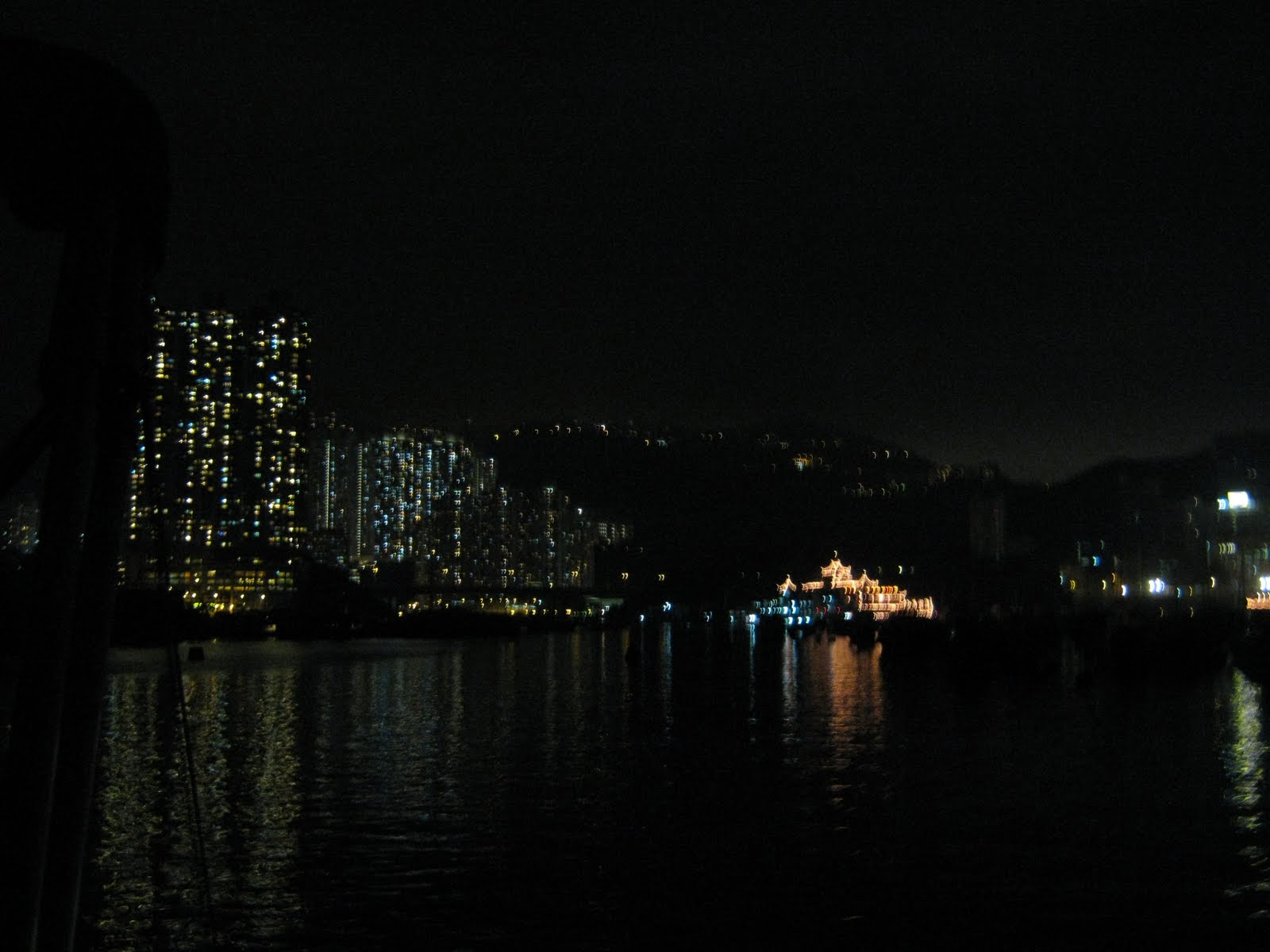
You’re on the yacht, coming back from Lamma Island after dinner with your project sponsor and the rest of the group.  The sea is calmer than the trip over, the air balmy for April.  You’ve had a lot of red wine—between servings of prawn and welk, the waiters just kept pouring—but not too much. 

Behind you are the lights of Lamma:  a row of restaurants on stilts, an assortment of wooden fishing boats, UFO-shaped yachts and mussel farms; above them all, dark mountains barely visible against the night sky. 

In front of you glows Ag Lei Chau, the small island just off the south end of Hong Kong Island.  The apartment complexes there are 42 stories high, and they glow like Christmas trees would, if Christmas trees were black and orange and rectangular and 42-stories high. 

There were maybe 20 people in the party.  Only four of you have climbed up to the upper deck, though, with the warm night air, and the lights glowing off the dark water in front of you and the dark water behind you.  Joe stands, his hair tucked into his collar so it doesn’t snap in the wind.  Younger David sits beside you, the arm of the sports coat that you like so much brushing your sleeve as he talks.  Older David, a native Hong Konger who’s sister lives in one of those buildings you’re cruising toward, sits on the other side, listening, occasionally tilting his head away from the hum of the motor. 

These are three of your favorite people:  Joe is one of the gentlest men you know.  Younger David surprises you with his jokes, delivered with just the smallest upward turn of his mouth.  Older David has taken it upon himself to introduce you and the rest of the group to the best noodles, the best hotpot, and the best tailor in Hong Kong.  Without any of these three men, this trip would not have been everything it is. 

So you’re sitting there, and the wind blowing, and the boat bobbing, and those lights glowing in front of you so beautifully that you start to tell a story.  It’s about your junior year when you lived in Durham and about how on the last night you were there you went out dancing with friends.  And it got late and you got sweaty and for some reason you ended up walking home with this girl named Lisa who you know and who you liked well enough, but who wasn’t one of your best friends or anything. 

Immediately someone on the boat wants know if this story ends with sex, and you have to disappoint them by saying it doesn’t, though there was this one time when Lisa showed up for breakfast at St. Aidan’s College where you both lived, took one look at you, and fled, her face bright red.  Turns out she had a sex dream about you.  You know this, because two days later she came up and told you the so, concluding with, “What’s weird is that I don’t find you the least bit attractive.”

So no, you tell the two Daves and Joe, this story most certainly doesn’t end with sex.

What it does end with is you crying.  This is your last night in England, after all, and you’ve been there for a year, and it’s been without question or exaggeration the best year of your life, because in Durham you’re on your own and exploring a new country and you’re special and different and every day is surprising and scintillating and you learn more about who you are and what you’re capable of than you ever thought you could. 

So you’re walking home with this Lisa, this unattracted-to-you Lisa, and you’re strolling up the cobblestone streets that rise along the river and across from the Cathedral, and suddenly the Cathedral bells begin to toll. 

Durham Cathedral, for anyone who hasn’t seen it, is one of the most magnificent buildings in the world.  Built starting in 1093, it looms above the River Wear on a broad peninsula, its central tower thrusting up from a squat body at once grounded and elegant.  At night when it’s lit by spot-lights, its gothic detail take on the quality of lace. 

It is gorgeous.  And with its chimes striking every quarter hour, it is a constant reminder throughout the year that you are somewhere far far away from the cornfields of Wisconsin.

And that night, walking with Lisa, when the chimes begin, you burst into tears. 

Poor Lisa.  Here she is with a guy she wasn’t that attracted to, a guy she doesn’t even know that well, this lanky American with long blonde hair and a pointy nose—and he’s weeping like an eleven-old who’s just lost his puppy. 

“So what was that all about?” Joe asks.

“Lisa,” intones the older David.  “He wanted to get lucky, but she wasn’t interested.”

 You don’t know, you say to Joe.  But then you do, and you explain it as best you can:  you’ve realized, at that moment, walking up that hill, that you would never be in this beautiful, amazing place again.  Oh sure, you could—and would—come back to Durham in the future:  you could wander the cobblestoned streets, you could slam pints in the smoky pubs, you could pause on Prebends Bridge, looking down at the slow moving water, the weir, the mill house, that insanely gorgeous cathedral.  You could be there—but you wouldn’t be of there.  Touring around for two days while you crash at a B&B isn’t the same as living in a college with 300 other kids your own age and wandering past medieval buildings and ancient sandstone walls so often that you don’t even notice them—except for every once in a while when you stop and look around and suddenly think, “Holy crap.  I live here.” 

Older David shakes his head.  “You’ll be back.”

“Yeah,” says Joe.  “There’ll be lots of opportunities.”

The lights of Ag Lei Chau are closer now, on the left.  The yacht’s captain is steering toward the entrance of the Aberdeen harbor, slowing the engine to a slow grumble. 

“I know,” you say, even though you don’t.  You have three kids after all, and a wife with a busy job, and Hong Kong is twenty hours away by plane, and expensive as hell.  It’s entirely possible, you think, that you’ll never see any of this again. 

“You’re not going to cry again, are you?” says younger Dave.  “Because if you start, I’ll probably join you.”

Everyone laughs, and the conversation shifts to one of the writing projects you’ve all been working on together, a collection of essays about reflective moments during your time here.  You ask older Dave if he’s got a topic yet, then mention a conversation way back in October, when he complained about the administrative bullshit that riddles HK universities.

“I never said that,” he says.  Light from the harbor is flashing off his glasses. 

“Yes you did.”

“I never use words like ‘bullshit.’”

Which is true.  You know this the moment he says it because you suddenly remember all the times you dropped a casual cuss word in his company and he just looked at you like you were an idiot. 

You like him, and want him to like you, so you try to redeem yourself.   “You do know why I swear so much, don’t you?”

Again, that flash of the glasses.  You wish you could see his eyes, but the funny thing is, you know it wouldn’t help.  Both Davids are masters of the straight face. 

“No.”

“Because I’m a pastor’s kid,” you say.  “And I was too scared to drink or smoke or get laid.  So I took to swearing.”

“I’m a pastor’s kid,” he says.  “Are you saying I did all of those things?”

You weren’t, of course, because you didn’t even know his dad was a minister.  But this is David, and half the time you just have to go with it.  So you look straight at him and say, “Yes.”

He laughs.  The boat is in the harbor, now.  Rows of flats crawl up the steep hills tower on both sides of the water:  through open curtains you can see flashing televisions, hanging laundry, an old man in a tank T smoking a cigarette.  David starts to tell a story about the first time he got drunk.  He was with his father, and it was the ordination of a new church, and the waiters came around offering drinks to everyone.  Randomly, David chose gin. 

“Did you get sick?” you ask.

“No.”

“Did you act like an idiot?” 

“Not really.  I still knew what was going on.”

Huh.  You nod.  It’s not really the way you wanted the day to end, this peculiar conversation where you look sort of foolish and where all the jokes are someone else’s.  The wine is wearing off now, and the spotlights and glowing blue-white halogens are scraping the romance off the evening, though the memory of that night in Durham more than 20 years ago still hovers at the back of your skull.  It’s stupid, you know, to be feeling so melancholy so soon.  You still have two months in Hong Kong, not to mention two weeks’ worth of travel through Malaysia and Cambodia.  Life is good.  This is a good gig. 

But you also know how fast time goes.  Most of you are doing a workshop a week now, sometimes two, and between that and the day-to-day business of designing and implementing new programs and stuffing your face with dim sum and taking pictures and writing blogs, weeks go like days and days like hours.  It’ll be over soon.  Soon, you’ll be someone who used to live in Hong Kong.

The yacht turns.  On your left is Jumbo, a giant floating restaurant glowing with twelve thousand Christmas lights.  The food there is mediocre, but tourists flock to it anyway, despite the fact that it’s just like any other restaurant, only on water.  What would happen, you wonder, if a dentist set up shop on a boat, then made a big deal about it, publicizing it in the papers and on TV.  Would people fight to get in, just because it’s on water?  What if the dentist were bad at his job? 

The ship docks with a bump.  Joe and the two Davids have gone down the stairs now, leaving you alone on the upper deck.  You put your hands on the wooden rails, preparing to descend.  Then you pause.  You look around.  Glowing lights.  Too much light.  You try to remember what it was like on the water, the boat smooth through the waves, the breeze warm and moist.  You wonder if someday, when you’re 90 maybe and sitting in a retirement home watching cardinals outside in the snow, your blue-veined hands on the blanket over your knees—if at that moment, you’ll suddenly remember this night, the wind, the lights, the feeling of being somewhere special and being someone special and doing something that only a few people ever get to do in their lives. 

You don’t know.  The boat is secure now, the guests are on the dock, chattering.  Someone laughs and someone else says, “Excuse me.”  You know they’re probably waiting for you.  You don’t care.  You just want to stand up here, on this deck, on this boat, in this harbor, on this island, with this wind on your face and the smell of the salt in your nose and the air in your lungs—you just want to stand here a little bit longer. 

Monday, May 3, 2010

China Rising, Part II: Crush

I need to begin by saying that it’s always been more or less understood in mine and Ellen’s relationship that crushes happen, and that, as long as no action is taken, they’re not the end of the world.  This perhaps explains why Ellen insists we watch every movie in which David Straitharn appears, no matter how minor his role. It might also explain Ellen’s willingness to support my assertion that Jennifer Anniston is one of the greatest actresses of our age, a claim most of my friends fail to understand, and which I can only support with these five words:  “perfect comic timing,” and “perky butt.”

But the occasional crush on a real live person is acknowledged in a good-humored way as well, as long as it lasts no longer than, say, two hours—and again, as long as no action is taken.  So Ellen tolerates my kind words about a certain brilliantly geeky kindergarten teacher, and I don’t get stressed over Ellen’s affection for a particular local artisan with strong hands, a talent with tools, and horrifyingly thick hair.  We both understand, of course, that he is married, and Ellen is married, and that this is the way it will remain, barring a bizarre automobile accident involving me, the artist’s wife, butane torches, a tank full of gasoline, and a severed brake line—at which point I would except that said artist would be more likely to be invited to our house for lasagna than, say, Marvin, who lives across the street, mows his lawn twice a day, and regularly sends a portion of his social security check to an organization in Nigeria claiming to have found the original Noah’s Ark. 

All of which is simply a precursor to saying that when we were in China, I fell in love with and proposed marriage to all three of our Chinese guides. 

Now, I know this maybe sounds “kooky” or “weird,” a little “wrong,” or “sick,” or even just flat-out “inappropriate” and “immoral.” 

But it’s worth pointing out that we are in Asia, after all, and Asia is, as many people (some of them Asians) have noted, full of Asian people.  And Asian people are as a race--as many people (some of them Asians) have noted--not unattractive. 

Such a view is particularly common among people from Wisconsin, a state known for its cheese, its beer, and its big butts.  It’s also a place filled with people who are blonde-haired and blue-eyed, although I did once meet someone who claimed to be “Italian,” or some such thing, and who got rather angry when I laughed and said, “Oh sure, like those are real.  What next?  Your mother’s an elf?”

Actually, to be frank, I didn’t really propose to all three of our guides, though I did like them each a great deal.  Bing, our first guide, who met us in Beijing and stayed with us throughout the trip, was smart as hell, with a wonderfully dry sense of humor.  She was also perfectly calibrated to handle a bus full of children, joking with them and asking them questions that made them think, but also putting the hammer down and getting serious at the appropriate moments.  Jing, our guide in Xi’An, was statuesque and broad-faced, the daughter of a successful basketball player.  She wore cool glasses and could talk about Chinese pop culture for hours.  She too, was great with kids and great with adults, and didn’t take us to crappy souvenir shops where people tried to sell us polyester shadow puppets for 300 RMB. 

And then there was Ling. 

How can I describe Ling? 

Her hair was like clouds of coal dust, floating over a Dickensian city; her eyes were like two black gumdrops with all the sugar licked off; her lips were—

Well, okay, so I’m not Shakespeare.  Suffice to say that Ling was very pretty, yes, and very smart, indeed, and kind to all of us, even this one, dumb, white guy who kept following her around and asking her questions like, “Is the sky always blue in China?” just so he could be in her company. 

But the thing about Ling?  Really?  Besides the fact that that would make a great name for a musical?  The thing about Ling was that she was amazing with kids. 

And I don’t mean amazing, amazing:  I mean amazing.

Keep in mind that this is a woman who glows in any circumstance:  she has these dimples, see, and this broad smile, and these Kilroy/jack-o-lantern eyes (that’s a compliment, trust me) that seem to be lit under the worst of circumstances.  There’s just something about Ling that makes people want to be in her company. 

Around kids, all of this gains extra wattage:  her grin becomes ear to ear, her eyes become more animated, her hands dance.  She tells them jokes, she listens to their stories, she holds their hands while crossing the street, she peels their oranges.   The afternoon we went to the People’s Park in Cheng Du, she warned us there would be fortune tellers, then gave us a brief lesson on reading palms.  After that, of course, all of the children were checking out each others’ hands, discovering they would all live to 106 and become billionaires. Eventually, most of the them wandered to Bing for an expert reading.  There were 7 kids on the trip at the point, and my guess is she read at least 6 palms in the next hour, some of them twice. 

“Wow,” I said to Ellen, watching all of this.  “That woman needs to have some kids.”

Now I know this is a stupid thing to say—stupid, and sexist, and essentialist, and neandrathal-ish.  In my own defense, I’ll point out that I say this—that X or Y needs to have kids—about men as well as women, and that most of my male friends are the kinds of guys who, like me, couldn’t wait to be a dad.

Additionally I’ll point out that I don’t buy the idea—propagated by the religious right, Tea Partiers, and lobotomy victims everywhere—that a woman’s natural function in the world is to walk around sweaty, uncomfortable, and easily annoyed for nine months until going to the hospital, screaming for 16 hours, and having a baby that she can then carry on her hip for the next two years as she makes me lasagna. 

I know, of course, that there are plenty of people out there who don’t want kids.  I know that there are folks who come home at the end of the day, pour themselves a glass of wine, curl up on the couch with a novel by Dostoyevsky, and thank God almighty they don’t have to listen to some kid screaming, “But I don’t want to watch Bugs Bunny!” and “If you touch my airplane one more time, Pooh Bear’s going to lose a finger!”

I know there are people like this.  And I’m fine with this:  I love these people.  I admire these people.   I respect these people.

I’m just not one of these people. 

I’m the kind of guy who has to carry an oxygen tank at work, because I can’t breathe right until I’m home and lying on the living room floor, Lucy pretending she’s barfing every time she smells my breath and Will telling me about the submarine he wants to make out of a plastic bottle, two rubber bands, and three ounces of weapons-grade plutonium.  I’m the guy who actually enjoys telling his three-year-old son, for the fifty-second time this week, that you need to pull your underpants up first, then your jeans.  I’m the guy who thought that “love” was a myth created by Hallmark until the first time I had to change a diaper and said—out loud, to my friends—“It actually doesn’t smell that bad.”

Ling, in my mind, is one of the latter group of people.  I don’t doubt it for a minute.  Watching her reading Will’s palm that afternoon in the park, I leaned over to Ellen and said, “I’m going to take Ling home and marry her.”

Ellen nodded, giving me a pat on the shoulder.  “You do that.”


And I would have, too.  Then the next morning, when we’re at the airport, about to fly back to Hong Kong, I asked Ling when she and her husband were going to start having kids of their own.

“Oh,” she said, glancing up at me, a little startled.  Her eyes had been following the random wanderings of the children, seven grounded flies buzzing around the airport.  “I don’t want any kids.”

The only thing that kept me from falling over was the fact that everyone else in the group looked just as stunned. 

“Really?” said one of the mothers, her jaw open.

Ling nodded, still glowing in that glowing way she had of glowing around children, particularly when she was glowing. 

“It’s because your husband is so ugly, right?” I asked hopefully.  “And short?”

Ling laughed (See?  She loves my quirky sense of humor!).  “He’s short,” she said, “but not ugly.”

“Still,” I said.  “Short is bad.  Very bad.”

“He agrees with me,” she said.  “We want to concentrate on our careers.  Children take too much time.”

“Your careers?” I echoed.

She looked up at me.  Her eyes were a bit more serious now.  “Yes.“

“But you love kids!” I said. 

She nodded. “Lots of young people in China are thinking like this.  We want to get ahead.  We want to make a life.” 

She turned, then, and led the group under an escalator and toward the ticket counters.  She was holding the red flag of our tour company, the one with the face of the little girl returning to China on it. The irony of all of this—here was a woman who was great with kids, but didn’t want any, leading a tour full of people who’d spent buckets of money to adopt kids because they really wanted them—flew right past me at the moment.  I was just that stunned.

When we got in line, I shoved a couple of old German ladies out of the way and squeezed up next to Ling.  Tapping her on the shoulder, I waited until she looked up at me. 

“But you love kids!” I said.

She smiled. “My generation, we want things to be perfect before we have children.  If we can’t have it be perfect, then we don’t want to do it.”

I shook my head.  “But you love kids!”

“But they’re very expensive,” she said.  “If you want a good school, you must pay for that, and if you need help, you must pay for that.”

I tried to think of something to do other than stare, but I have to admit I’m not sure I succeeded. 

She watched me, still smiling that glowing smile, still flashing those glowing dimples, still shining those glowing eyes.  Then she gave a small shrug.  “This is my generation.  This is how we think.” 

Thursday, April 29, 2010

China Rising, Part 1: The Wild West

We’re sitting in a restaurant in a village outside of LiJiang.  It’s our second day in China.  The kids are eating chicken and pork, fighting over a can of Sprite, and playing mini-mysteries:  A man is sitting on a bed.  He makes a phone call, listens for a moment, then hangs up and goes to sleep.  Ellen is feeding Jamie.  And I am watching Haba.

Haba is our guide.  He’s maybe twenty-five, with a high, round nose and slightly spiky hair.   Right now, Haba has his head down.  He’s pulled something out of his pocket and is bent over it.  He’s not moving, which is weird, because Haba is wiry and active, tapping his foot, usually, or his fingers, or twisting in his seat to look around him. 

Now though, he’s simply looking at his hand, at the paper there. 


We love LiJiang.  Driving in from the airport the day before, we climb up the side of a long, green valley surrounded by brown sloping mountains.  It looks like the Shenandoah Valley, actually, but the quality of light is different, softer somehow, more defused with moisture, making the greens greener, the sky bluer, the browns more fecund. 

Haba is our local guide, and we like him almost as much as we like LiJiang.  We’re not in the van ten minutes and already he’s telling us about the various ethnic minorities in the region.  The Na’xi are the dominant group, he says, the oldest group, the ones with all the power, who own the restaurants and the buildings that store owners buy.  There are also the Bai, and the Yi.  The Bai are, according to Haba, “very elegant.”  They make silver and dress well, and are very beautiful.  The Yi are less clean, and have their own religion.  They keep to themselves, don’t marry other ethnic groups.

Haba is a Pumi.  The Pumi, he tells us, are descended from nomadic tribes, maybe even Genghis Kahn.  They came to the valley 800 years ago.  They are very strong, and ruled the region for a long time.  Now, though, they live in the forests, and are so impoverished that the government doesn’t hold them to the 1-child policy, fearing that to do so would mean eradication of the race.  Pumis, Haba tells us, eat mainly potatoes and corn. 

We’re enamored.  Ten minutes outside of LiJiang, the proud crest of Jade Dragon Snow Mountain appearing on the horizon, brushed by plumes of evening clouds, I lean over to Ellen and say, “Let’s cancel the rest of the trip and stay here for two weeks.”

She nods.  “No kidding.”


The next morning, Haba takes us into the “old town” portion of LiJiang.  This part of town is filled with attractive buildings made with dark wood.  Red lanterns hang from many of them, and on some are carved bright red characters.  There are canals in LiJiang, and flower boxes brimming with blossoms.  It’s early April, and we’re in the mountains, so the trees haven’t leaved yet, though you can see a light green tinge at the ends of branches. 

In other words, it’s a nice place.

We walk through the town, glancing at the souvenirs—Tibetan prayer bowls, painted wooden carvings, fans, kites, and hand-woven shawls—then watch some ethnic dancers for a while.  They’re mostly women wearing blue skirts over pants, maroon tops, and intricate patterned leather shawls over their shoulders.  If anyone’s every doubted Asia and North America used to be connected, watching these women dance would erase those thoughts:  the costumes, the shuffling steps, the low singing exactly resembles a pow-wow.  

Eventually talk turns to our itinerary.  Haba mentions that the music show we were supposed to see that night isn’t very good for kids.  “Too boring,” he says, waving a hand.  “Many people tell me this.”  There’s another show, he says, with dancing, much more colorful, much livelier, much better for children. 

This sounds great, of course.  The only thing worse than a show that starts after the kids’ bedtime, is a show that starts after the kids’ bedtime and bores the living crap out of them. 

“What about the cost?” I say.  “Is it the same price?”

No, Haba says.  Ninety more.  About 13 bucks, US. 

I glance at Ellen.  This isn’t much by US standards, but in China, it’s a ton.  Our meal the previous night—all eight courses of it—totaled 150 RMB, and we included Haba.

“90 each?” I say. 

He nods.

“Hmmm,” I say. 

“To tell the truth,” Haba says, “this whole trip, it’s not very good for children.  There are many better things to do.”

Like what? 

He lists a number of things:  horseback riding, boat rides, the dance concert, some big park that everyone likes to go to where there’s a really old fresco.

I look at Ellen again. The company we’re working with is family friendly, we know, but it makes sense that they might have missed something, that after they set up the tour, they went back to Beijing and missed a whole lot of things that came later. Horseback riding sounds like fun, especially if we can go into the mountains that surround the city.

“If you want, I can do a package,” Haba says.  “I’ll set it all up.   Everything for 400.”


After we booked our tour, the company we were working with sent us a bunch of materials to read as we prepared for our trip.  We ignored most of it—we were seasoned Asia veterans after all, having had diarrhea in at least three different countries—but a section called “Safety Tips” caught our attention.  Among other things, it told us, “Passports should be kept with you daily.  Hotel safes are only as safe as the front desk clerk is honest.  That is, the access to the safes is greater than you may realize.  Hotel housekeeping and desk clerks usually have key-entry access.  Therefore, do not leave passports or valuables in the in-room safes unless you have no other options.”

Reading this, Ellen and I looked at each other.  We’d kept our passports in every safe in every room in every hotel we’d been in thus far in Asia.  In addition, we’d left huge wads of money, multiple books of traveler’s checks, three pounds of raw heroine Ellen had stolen from the bullet-riddled corpse of a nun working for a Hong Kong triad, and Ba-wa, Lucy’s stuffed puppy. 

But there was more.

“Pickpockets and slashers (slash your bag/purse) exist at most tourist attractions in Beijing and street markets.  Beware of this.  Carry money in private bag under clothing.  Carry backpacks in the front of you when at crowded markets.  Lock zippered compartments.  Beware of those who wish to have photos taken or sell you things in the Summer Palace as a diversion.  No harm will physically come to you, it just may be that money is stolen or a camera.”

“Wow,” I said, reading this.  “I’ll shave my body.  That way we can duct tape our passports to my chest.”

“Don’t be silly,” said Ellen.  “We’ll use staples.”

The literature went on:  “Watch for fake money at the Summer Palace and throughout China.  It is best not to buy things while at the Summer Palace—there is a switch of the money and your change could be fake.  They will tell you your money is bad and then give you a bad bill back!”

And:  “Be careful at restaurants.  Pay in cash only, as credit cards will be copied and sold to Malaysian drug syndicates.  Waitresses have also been known to follow small children into the bathroom, corner them, and demand candy.  Please remove all Reeses-Pieces from your kids before you come to China.”

And further:  “Wear metal underclothing.  Grandmothers in China tend to hate people like you, and will stick a shiv into your sternum first chance they get.”

“Damn,” I said to Ellen.  “Told you we should have booked those tickets for Iraq.” 


It doesn’t help, of course, that we live in Hong Kong.  Hong Kongers are so honest you can leave your baby holding the keys to your Rolls-Royce sitting in a $40,000 gold-plated stroller next to your laptop and new digital camera, and come back six hours later to find it all still there (except for the baby, who’s likely  crawled off for some curried fish balls). 

Seriously, you can be at an intersection where the sign is flashing “Don’t Walk.”  You look to the left.  No cars.  You look to the right.  No cars.  You look to the let again:  still no cars.  Indeed, now you notice tumbleweeds and a pair of squirrels playing Monopoly in the middle of the road.  You look at your fellow Hong Kongers.  They just stare straight ahead, watching the “Don’t Walk,” sign. 

They don’t walk. 

What’s more, Hong Kongers aren’t quite sure what to make of their cousins to the North. 

Actually, let me rephrase that:  Hong Kongers are afraid of the Mainlanders. 

“Been to Shenzhen yet?” a colleague asked me a few weeks ago.  He was referring to the busy metropolis of 20 million just across the HK border.  Shopping is plentiful and cheap in Shenzhen, and almost everyone we know goes up there regularly to load up on tailor-made suits, designer watches, and household furnishings.

No, I told my friend.  We haven’t had a chance to go there.

“Don’t take the kids,” he said. 

I looked at him. 

“It’s dangerous,” he said.  I raised my eyebrows, and he nodded.  “That’s right:  kidnappers.”

In a way, this made me want to go to Shenzhen all the more, if only to see some kidnapper trying to explain to a childless Chinese couple that, really, their neighbors wouldn’t notice if suddenly there appeared a blonde-haired, blue-eyed six-year-old in their yard. 

To an extent, Hong Kongers’ fear of Mainlanders seems entirely justified.  Mainland China has the feel of the wild west:  crime is higher there, and more violent.  Bing, our guide in Beijing, told us that almost every businessman who’d made a killing since economic reforms started has since been indicted for one thing or another.  Graft is everywhere:  in the government, in sports, even in academics.  Perhaps this is not surprising:  the average yearly income in China hovers around $1,000 US.  I know eighteen-year-olds who get better allowances.

Paradoxically, last year China gained more billionaires than any other nation in the world, and now has more of this breed than any country other than the US.  Ten years ago, when I first visited China, Beijing was thick with bicycles—hundreds would pour past as we strolled along the side-walk, wheels spinning, bells ringing, riders erect in the seat.  Now, almost everyone in the city owns a Volkswagon, a Ford, or an Audi.  You can encounter a traffic jam anywhere, at any time of day.  Bikes are non-existent. 

And then there’s the notice in the room guide at our hotel in Beijing.  Just after the list of phone numbers (Dial *12 for Room Service; Dial *7 for laundry; Dial *8 for the hookers in the barbershop) and just before the hours of the fitness center was a short statement: 

“Please note that guns should be secured in room safes at all times.  Firearms left unsecured will be confiscated by the cleaning service.”

Let me be frank about this:  I’ve been to the Soviet Union.  I’ve been to East Africa.  I’ve been to Texas.  And never—NEVER—have I seen a notice like this. 


Which brings us back to Haba, in that village outside of LiJiang, at the restaurant where we’re eating lunch.  Haba, who is bent over a packet of paper, staring at it silently as Jamie eats mushrooms and Lucy asks me if, maybe, the man on the phone in the room is calling his mother to find out if she can scratch his back. 

“No,” I say to Lucy, though I’m still watching Haba.  Why’s he just standing there? 

After some thought, Ellen and I had declined his offer to add on additional family-oriented pleasures in and around LiJiang.  It all sounded very fun—especially the paragliding with Tibetan monks—but we’d already spent a bucket-load on the trip, and $300 US more just seemed like a lot on top of it all.  This seems silly, I know—we’re from the West, after all, and we make more money than the Chinese—but we live in Hong Kong which isn’t the cheapest city in the world, and we have three kids, and it’s not like I’m a doctor or a lawyer or some rich Tea Party supporter. 

Haba took our rejection well, just shrugging and ambling on through the market.  At lunch, though, he comes over to tell us that, if it’s okay, he’s going to leave us with the driver for the afternoon.

“There’s another group that’s going up the mountain,” he says, referring to Jade Snow Dragon Mountain.  Then he gestures apologetically.  “It’s been slow for four months, and now, all of a sudden . . ..”  He lets it trail off.

No problem, we say.  We understand that he needs to make a living.  We’re just going to spend the afternoon wandering, anyway.  We don’t really need a guide. 

“But what about this park or whatever?” I say.  “The one you mentioned with the frescoes.  Is that worth seeing?”

“Oh yes,” he said.  “It’s beautiful.”

“So what if we wanted to see that?” I said.  “You know, as something extra? Would we be able to get tickets?”

“No problem,” Haba says.  “I can give you some.”

“But we’re not sure,” I tell him.  I’m thinking of the 400 RMB package he mentioned earlier.  This park, these frescoes were part of it.  “Can we just pay you if we use them?”

“No problem,” he says again.  “I’ll leave them with the driver.”

And then he unzips his fanny pack, reaches in, and begins to rummage around.  Eventually he pulls out a few strips of paper, connected at one end, and looks at them. 

And then he freezes. 

I watch him, trying to figure out what the heck is going on.  Lucy has abandoned the 21-questions game, now, is making better use of her time by poking her baby brother with a chopstick.  Ellen is trying to get Jamie to eat a piece of beef covered in tomato juice.  Will is ignoring his food, concentrating on a small brass contraption he bought that works as a crude lock. 

I take all of this in, then reach for a piece of deep-fried yak cheese dusted with sugar.  It tastes a little greasy, but sweet and okay, too, and I chew, glancing back at Haba.  He’s still staring at the packet of paper, the fresco tickets, I assume, the one’s he’s going to sell to us if we decide we want them. 

I stretch my neck, try to raise the angle a little, get a better look at what’s in his hand.  It works.  Up higher, I can tell they are tickets, five of them, stapled together.  Attached to the top, also by staple, is a piece of white paper containing two carefully printed words: 

Ellen Satrom.

I sit back down.  I look at my food.  I can feel my face turning red.  I glance at Ellen, trying to catch her eye, trying to see is she knows what’s going on, if she sees why Haba is standing there, staring at those tickets, frozen in mid-gesture.

They’re our tickets. 

They’ve always been our tickets, included in the price of the trip.

He’s been trying to sell us our own tickets.  


Saturday, April 24, 2010

Perfect

Imagine a man, standing on a slack wire.  The wire stretches from two poles, ten feet off the ground, and bows so that the man is perhaps 4 feet above the wooden stage. 

Now imagine that man walking on that wire.  He steps forward, lowering the wire before him, and raising it behind.  Then he steps back, raising the wire in front of him and lowering it behind.  He turns nimbly on one foot and goes in the opposite direction.

Now imagine that man laying back on the wire, legs stretched out and cross, arms on his chest.

Now he undulates in prone form, causing the wire to swing back and forth in 12-foot arcs.  Back and forth, back and forth he goes, so that when he’s at the back of the stage you can see the top of his far shoulder, and when he’s toward the front of the stage you can see the bottom of the same shoulder—he’s that high in the air.  It’s that much of an arc.

Now imagine him getting a ladder.  “A ladder!” you say.  “How wonderful that a man could stand on a ladder on a one-inch slack wire four feet off the ground!”

Well, yes.  But even more amazing is that he doesn’t stand the ladder straight on the wire.  No, he leans the ladder toward the back of the stage at a 40-degree angle.  Then he places one hand on the far end of the ladder and the other at the near end of the ladder, just over the rope.

And very slowly, he raises first one foot, then the other, above the wire, angling them toward the audience, toes pointed, counter-balancing the weight of the ladder with the weight of his body.

And there’s more.  Done with the ladder, he is handed a unicycle.  Which he stands on the wire.  And rides, of course. 

On his face.


Sometimes I get sick of my own voice.  Sometimes, I imagine I’m my “audience” (if you can call my Mom and six ex-convicts an “audience”), reading yet another one of my over-long posts, and getting to the end and reading some cute line about my daughter, or about my falling in love with China or about some great deal I got or some poetic realization I had—sometimes I imagine myself as that audience, reading that post, and I roll my eyes and gag, thinking, “Oh geez, here we go again.”  More hyperbole.  More sentimentality.  Who do I think I am, Disney?

Or worse than Disney, really.  At least Disney killed Bambi’s mom.  I wish I had the guts to kill Bambi’s mom. 

That sounded better in my head. 

At times like this I want to write a piece of cutting social commentary, something rapier-like in its wit and breath-taking in its undermining of contemporary American or Asian or American-Asian culture. I want to drip acid on metal until it makes an edge both cutting and beautiful, but more cutting than beautiful. I want to drop a bomb and really piss people off, and swear too much and shock folks by telling them something they’ve known all along, but were too scared to admit, even to themselves, until I came along with my refusal to wrap the world in sepia tones and gingerbread crumbles.

I want to be Augustine Burroughs with more social conscience, or William S. Burroughs with fewer drugs.

Oh well. 


I mention the slack-wire man because he epitomizes our experience in Beijing watching the China National Acrobatic Troupe:  every moment surpassed the moment before.  First we were amazed by the contortionists balancing (obviously glued together) wine glasses on their fingertips, toes, backsides, and noses;  then we were stunned by the tumblers who could run across the stage, leap into the air, pull a full somersault, land on their toes, and leap through a hoop ten-feet up; then we were mildly amused by the fourteen-year old kid tap dancing and juggling 9 balls and the woman balancing two open umbrellas on one foot while turning another one with her other foot while spinning two clothes on her fingers.  The six men scampering up thirty-foot poles and sliding down, face first, halting only an inch from the ground were pretty amazing, as was the closing act:  twelve women riding bicycles around the small stage, first in single file, then side by side, and then with all twelve on one bike. 

No kidding. 


And I mention the China National Acrobatic Troupe because it epitomizes the experience of our two-week tour of the mainland:  sure, the Acrobats were great, but so was the Great Wall, and the terracotta warriors.  Then there was the silk-rug factory where the kids got to actually weave silk rugs, and the art museum in Xi’an where the kids were taught the eight strokes of Chinese characters and got to spend almost an hour doing calligraphy.  There was the show we saw where the kids got to pose afterwards with actors in traditional Chinese makeup and costume, and the show we saw where men spit fire five feet into the air and dancers switched masks—“faces”—so quickly we spent most of the night lying awake in bed trying to figure out how the hell they did it. 

And there were the pandas.  Have I mentioned the pandas?  Friggin’ Pandas everywhere (well, not actually friggin’, but you get my point). 

One of my many quirks—I hate lettuce, toast, and circuses—is that I’m not a fan of zoos.  For one, they smell.  For two they keep cute animals in circumstances I wouldn’t put a—well, a dog in.  But more importantly, every time I go to a zoo, Ellen assures me I’ll get to see tons of exotic animals that we otherwise only get to read about in kiddy books. 

“Elephants,” she’ll say, “and giraffes, and crocodiles, and panda bears.”

“Yeah right,” I’ll sniff.  “Like we’ve ever seen a panda bear in our lives.”

“Sure we have,” she’ll say.  “Lots of times.”

Well, maybe she has, but every time I’ve gone to a smelly, koala-torturing zoo, all I see at the panda cage is the back of some guy’s Nikon as he holds it up in the air, randomly snapping photos of palm trees and bamboo fronds in hope of catching something black or white or black and white that he can later tell his friends is a panda.  

“See it?” Ellen will say.

I’ll grunt.  “Of course not.”

“It’s right there.”

“Where?”

“Next to the tire swing.  See?  It’s eating some bamboo.”

I’ll lean to one side and stand on my tiptoes, figuring if a five-foot-seven woman with a two-year-old on her head can see a damn bear that really isn’t a bear, then I should be able to as well.

But all I’ll see is green and more green, and a cement wall where someone (likely the panda) has scrawled, “What R U staring at?  The real animals are on Wall Streat” (sic).

“I don’t see anything,” I’ll say. 

“It’s right there.   Oh, see?  Look!  It’s standing up!  And walking!  It’s balancing a pole on its nose and reciting Shakespeare!”

But all I’ll see is dark fronds, some sort of watering dish, and what might be a used cotton ball.

All of which changed when we signed up for our tour and went to Cheng Du, one of only three natural habitats in the world left for pandas.  There, I saw between 20 and 30 pandas, ranging in age from two-year-olds to fully-grown adults, in the span of just a few hours.  We’re talking baby pandas taking naps on top each other; toddler pandas trying to knock each other out of a favored seat; grown pandas wrestling not six feet from us.

And there were the panda hugs.

Okay, maybe not hugs.  These are live, wild animals, after all.   Big animals, with teeth and claws sharp enough to chew bamboo.  So we didn’t actually hug them.  But we got in the cage with them while they were busy chewing cane, and the kids got to pet them and get their pictures taken with them. True, these pandas weren’t the cleanest pandas I’ve ever seen.  It was spring, after all, and muddy, and it takes a lot of Herbal Essence to clean a damn bear (even when they aren’t really a bear)—but at least they didn’t smell.  And they were kind of cute, sitting on their hind quarters, resting the bamboo on their bellies and chewing away, holding their food with those wonderful opposable thumbs (which explains why pandas are the only critters who can play the french horn). 

And they were real.  Real  pandas.  And we were right there, with them.

Which was pretty cool.  Really cool.  Cooler even, than a man on a slack-wire. 


My dad always says it’s better to be lucky than good, and most of my life I’ve lived by this expression, adding, “dumb” and “cranky” to the list just for good measure.   Which explains how we ended up on this particular tour.  We’d already been to China three times at this point, but each of those trips was short and focused on a single destination or a pair of closely-related cities.  Ellen and the kids had never done the “grand tour” of China, per se, but the thought of trying to negotiate three or four different hotels in three or four different cities that we’d have to get to via three or four different airports made us just feel tired.  Maybe if we knew the language; maybe if our kids were older, or maybe if at least two of them weren’t prone to “accidents” on a regular basis and the third unwiling to eat anything that didn’t have the words “peanut” and “jelly” in the name. 

In short, we knew we needed to be on a tour. 

Which is too bad, because we’ve never been tour people.  We hate being dragged through places so quickly you can’t spend money on crappy souvenirs, and we hate being polite to people we barely know at the ungodly hour of noon. 

This in mind we went into the process of finding a tour agency pre-determined to be unimpressed.   And for a while we were:  this organization was too glitzy, that one too slick, this one set up solely to rip off people wearing adult diapers.  Eventually we narrowed to the search to a couple groups that said they specialized in tours with small children, but after getting an e-mail from the FBI suggesting that we reconsider some of our recent on-line activities, we pretty much gave up.

Until we got lucky.  I’m not sure what search terms we used, or who did the search, but somehow we ended up on a site titled, “Our Chinese Daughters.”  Looking at it, we realized it was an organization that specialized in tours for the adoptive families of Chinese baby girls—those daughters given away by families—often rural, often with other children—for a myriad of reasons relating to social pressures, the one-child policy, and a host of other issues.

“Holy crap,” I said, looking at some of the packages they offered:  “The Grand Tour,” “The Ethnic Minorities Tour,” the “Panda Hugs” tour.  Each of them promising unique experiences for everyone involved, and the opportunity for the returning Chinese daughters to “fall in love with China.”

“We don’t have a Chinese daughter,” Ellen said.

“We could dye Lucy’s hair,” I said.  “She’s been saying she wants to.”

“I don’t think a blue-eyed girl with pink hair is going to fool anyone,” Ellen said. 

“But look!”  I pointed to the screen.  “On this tour you get to learn a 10,000 year-old dance.”

“We don’t have a Chinese daughter.”

I turn to her.  Sometimes you just have to go real slow with Ellen—she’s an editor, after all.  “Listen,” I say.  “She’s our daughter, right?”

Ellen eyes me for a moment, then nods.

“And we live in China, right?”

She rolls her eyes. 

“Ergo—“

“Paul—“

“I’m just saying!”

What we end up doing is writing an e-mail to the Our Chinese Daughters Foundation and asking if non-adoptive families are also welcome.  They say yes so we sign up, send them our money, and get back into our daily routine for the next month or so.

It’s only when we arrive in Beijing and get the list of the other families on the tour that it suddenly occurs to us how awkward our participation in this group might be.  Adoption is about as perfect an institution as there is—I know this, having spent the last ten years watching my brother’s and sister-in-law’s lives grow richer daily as their daughter comes into her own.  I mean, what could be better than a child in need of a family bringing joy to a family searching for a child to love? 

But my friend Deb, who’s son came to her from Korea about the same time my eldest was born, points out, rightly, that adoption has its unique raft of challenges.  I’m tempted to list a couple of these—separation issues, etc.—but frankly, I only know enough about them to know that I should shut up and stay away from this particular field of eggshells (certainly a first in my life) out of respect for those who know more and for whom these issues are more than just theoretical. 

In short, we—or perhaps, more accurately, I—suddenly worried that our participation with this tour might interfere with something sacred:  a family with an adoptive daughter returning to the country of her birth for the first time.  One would anticipate that this would be a powerful experience, filled with complicated mixed emotions.  At times like these, is the presence of a big, fat gweilo who thinks he’s funny really that helpful?  (Actually, is there any time when the presence of a big, fat gweilo who thinks he’s funny really helpful?).   

In the end, we needn’t have worried.  One family told us they were just happy to have another boy on the trip, that they were concerned their seven-year-old son would feel isolated for two weeks.  And indeed, the children on the trip were a wonderfully mixed batch.  Besides our three, there was one other blonde-haired, blue-eyed kid—14 years old and gentle and funny and great with kids.  There was also a very small, very feisty England-born Chinese boy who prided himself, above all other things, on being from Liverpool.  And there were four Chinese daughters—two raised in Australia, one raised in the US, and one raised in the UK. 

My sense is that there were moments on the trip that were indeed sacred for these girls—and likely for the other kids as well.  There were pandas to hug, after all, and dance performances and music shows and getting to sit at their own table with no adult supervision. 

And my guess would be that other, more complex moments happened during the “add-on” portion of the trip, either before or after the tour, where the families went with their daughters to the orphanages where the girls lived between 6 and 18 months before adoption.  Very often, this part of the trip also included visits to the “finding place.”

This is a term I’d never heard before, and I haven’t figured out yet if it’s one that haunts me or reassures me.  A “finding place” is, of course, the spot where a child—almost inevitably a baby girl—is discovered.  Very often, though, it’s also a known spot, passed along by word-of-mouth, where babies are deposited and where someone—often the police, but not always—regularly checks.  It might be outside of a government building, or in a protected spot near a parking lot.  It might be anywhere.

Visiting her finding place, one of the daughters in our group got to meet and spend a little time with the man who held her until child welfare services came around to pick her up.  He was a nice man, a mid-level bureaucrat, quiet and gentle, and when the family asked if he remembered their particular daughter, he shook his head matter-of-factly—“There were so many,” he said through a translator.

Another girl, almost four, but the youngest of our group, actually bumped into the woman who found her.  The family was at the finding spot, looking around, and their guide tapped a woman on the shoulder, wanting to make sure they were in the right place.  She said they were, and told them she’d found a girl there herself.  The adoptive mother looked at her, wondering if it was possible.  The guide asked a question or two, and then another.  The woman answered all of them correctly. 


Of course, there were other intense moments on the trip:  there was the time all the orange popsicles were gone, and Lucy nearly cried because she hates—HATES—cherry.  And there were the daily arguments about who got to sit next to Caitlin.  And more than once I handed out M&Ms to some kid or other who’d just been up too late or who’d eaten only a mango and two rice crackers for lunch.  And then Ellen kept taking my seat on the bus and telling me I was nincompoop and—well, I won’t go there because the scars are just too fresh. 

Most of the trip, though, was brilliant.  When you’re with just your family, traveling with kids is hard:  ever day is a little like Lord of the Flies, and the only way to make it better is to start a pool putting bets on which kid will cry first, or throw up first, or get eaten. 

What we learned on this trip, though, was that traveling with kids is easier when you’re traveling with other people who also have kids.  It’s like some sort of bizarre physics principle, where you’d think putting more electrons in a given space would create more energy, more chaos, more collisions—but actually, it dissipates energy. 

And all of this was made easier by the fact that the tour company we used hired excellent and highly ethical guides.  Most trips to China will involve random stops at odd spots that don’t quite make sense, until you realize that what was advertised as a museum is actually a gift shop, and that your guide and/or bus driver get a commission on anything you buy there.

None of this happened on our trip though.  And Bing, Jing, and Ling (I’m not making this up) were all great with kids, great with adults, and willing to laugh at my stupid jokes.


In the end, I’m tempted to cap all of this off with some telling moment, some detail that creates symmetry or asymmetry or that just lingers in your head and makes you think about this post two days later when you’re bored and the bottle’s dry and you’ve just told the dog for the tenth time to please, damn it, stop licking my toes!

I’m a writer, after all:  I spend my life looking for moments that resonate,  collecting them, holding them in my pocket to draw out at the right time to offer to you like an afterthought so that I can appear deeper and more thoughtful and more perceptive than I really am.  Certainly, prior to this trip, I imagined there might be lots of moments like that, lots of moments when this or that kid—perhaps in her father’s arms, perhaps not—gained some sudden flash of insight—perhaps hard, perhaps poetic—into her life and her history and her place on this earth.

And certainly there were moments like that on this trip, maybe moments I saw, maybe some I didn’t—I don’t doubt it. 

But frankly?  Those moments are none of our damn business. 

So I’ll just end with this:  nine kids, some Anglo, some Asian, some young, some old, some loud, some quiet, some high strung, some patient, some able to wield a calligraphy brush like it’s an extension of her hand, others smearing paint across the page, some good at burping, some good at blowing raspberries, some polite most of the time but rude when they’re tired, others polite even when they’re exhausted, some funny, some with funny laughs, some ready to go to bed at 8 sharp and others ready to stay up watching Iron Man one more time. 

But all of them—all of them—sitting in a theatre in Beijing, with open jaws and wide grins, watching a man gliding along a wire on a unicycle, on his face.  Or watching twelve women form a pyramid on a rapidly moving bicycle drawing tight circles on a small stage.  Or watching a boy not much older than themselves pull Elvis moves in a glitter costume while juggling first six, then seven, then eight, then nine balls.  Or watching . . .

Well, you get the point.